There was always going to come a moment when petrol-powered cars started to feel old.
Not old in a nostalgic, classic sense. Old in the way outdated technology feels old. Complicated. Messy. High-maintenance. Built around servicing schedules, fuel costs, mechanical wear and an entire ecosystem designed to support that complexity.
That moment has arrived.
From where we sit, right on the coalface of the Australian car market, the shift is no longer theoretical. It is happening in real time. The questions have changed. A few years ago, most conversations around EVs were about hesitation. Range anxiety. Charging. Battery life. Whether people should make the switch at all.
Now the conversation is different.
More Australians are no longer asking, “Should I buy an EV?” They are asking, “Which one should I get?”
That is a major shift, and it says a lot about where the market is heading.
The range of EVs now available in Australia has expanded rapidly. There are more brands, more price points and more genuine options than ever before. What was once niche is now mainstream. Competition is improving the product, driving sharper pricing and giving buyers real choice.
And once people actually drive an EV, it starts to make even more sense.
Because the truth is, EVs are just better to drive for everyday life.
They are quiet, smooth, instant and packed with features. Yes, there will always be people who love a petrol car. I get it. I’m one of them. I love a bit of turbo lag, a loud characterful exhaust note, the quirks, the drama and the ability to tinker.
But is any of that really the best part of a 40 to 60 km/h commute? Not a chance.
Give me a quiet cabin, a heated or cooled seat, a quality sound system and a car that does the heavy lifting in traffic while I listen to my favourite music, and I am happy. The result is simple: I arrive more relaxed, calmer and generally in a better frame of mind.
That might sound a bit wacky, but it is real.
The first time I drove a Tesla Model S when it landed here, I knew the days of petrol-powered cars were numbered. Not because petrol cars suddenly became bad, but because EVs made everyday driving feel easier, more refined and more enjoyable in the situations most people actually face most of the time.
That is why this shift runs deeper than hype.
Yes, the economics matter. The EV discount has been a major driver, helping reduce the cost barrier and making EVs far more accessible to everyday Australians. In many cases, it is now more economical to step into a new EV than to keep feeding an ageing petrol or diesel car with fuel, servicing and unexpected maintenance.
That matters in a cost-of-living environment where households are looking much more closely at the real cost of driving.
But this change is not only economic. It is behavioural.
People are experiencing EVs and realising they suit modern life better than many expected. For commuting, school runs, day-to-day errands and city traffic, they are hard to argue against. Smooth delivery, instant torque, quiet cabins, low running costs and technology that makes driving easier all add up to a fundamentally better ownership experience for many people.
And that is where the Australian car industry may be underestimating the speed of the change.
This is not just a new category of car. It is a structural shift away from a platform built on complexity. Petrol and diesel vehicles rely on thousands of moving parts, ongoing servicing requirements and a long-standing industry structure built around maintaining them. EVs challenge that model directly.
That has implications well beyond what people choose to drive next.
It affects servicing. Dealer models. Used car values. Consumer expectations. And eventually, resale.
The hard question is this: in five years, what will a petrol or diesel car really be worth?
No one knows for certain. There will still be buyers. There will still be enthusiasts. There will still be use cases where internal combustion hangs on. But it is getting harder to believe that traditional petrol and diesel vehicles will hold value the way they once did, especially as EV adoption grows, technology improves and the market becomes more comfortable with the switch.
That does not mean every petrol car becomes worthless overnight. It means the long-term direction is becoming harder to ignore.
Personally, if I were putting my own dollars somewhere today, I would be putting them into an EV. Until the next major revolution arrives, I would not be going back to petrol for daily driving.
The shift is real. You can feel it in the market. You can see it in dealerships. You can hear it in the questions buyers are asking. What once felt like a future trend is now a present reality.
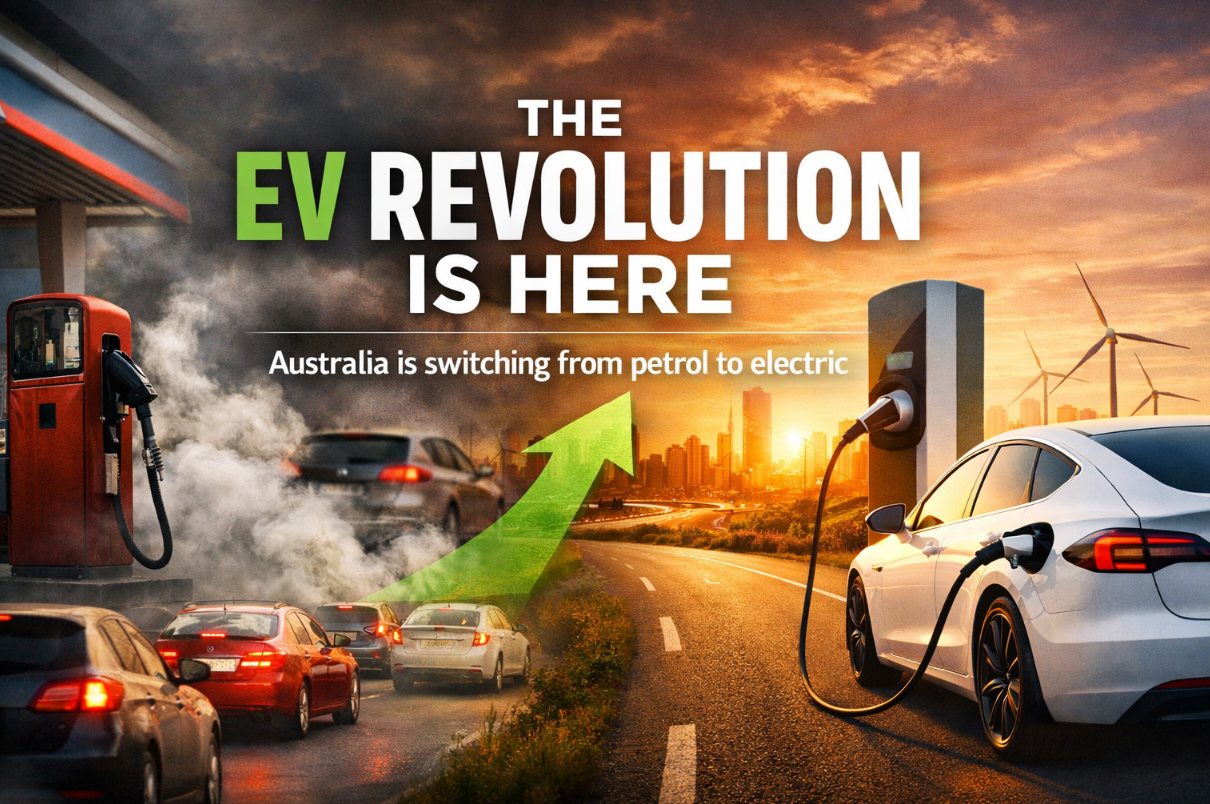
The EV revolution is here.
Not as a concept. Not as a maybe. Not as something years away.
It is here now, and the Australian car industry is changing faster than most people expected.